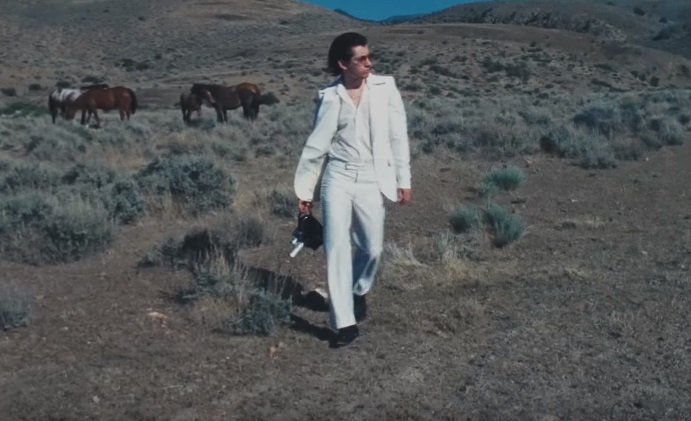
“First of all, there was a bloke with a phone and he says ‘Mark speaking’ and I’m like, where is he? I decided that he was there, at the Tranquility Base. It happened backwards like that.” – Alex Turner on Radio X.
I’ve written extensively on Tranquility Base Hotel and Casino covering its philosophical significance. In a previous article, I’ve Included a section on Mark’s origin. I compared the projection of Alex (Mark) to Hal in 2001: A Space Odyssey, and Einstein in World on A Wire. I highly recommend reading my previous work for a more in-depth look at my perspective.
There are countless interviews, critical and fan written articles, podcasts, and social media sound bytes covering this album. This article will be covering Mark’s origin, his white suit, the mirrored-cube featured on stage, and the theories of Jean Baudrillard and Marc Augé.
I’m sorry Dave. I’m afraid I can’t do that
I still strongly believe Mark is a projection or an avatar of Alex Turner in the world he created. Watching the films he mentioned while writing the album is a verification of that. In 2001: A Space Odyssey, Hal Is an AI unit with consciousness. In World On A Wire, the contact Einstein, is the only character aware of its world and the simulation it’s in. Just like Mark and Hal, Einstein is the central figure of the world because on quote, “without it, the simulation program can not run.”

In the film, the first contact, Einstein, lives in a hotel. When the protagonist is sent through the computer to speak to him in search of truth (like an oracle), he awaits to be signaled back to reality. He does so through a phone call.
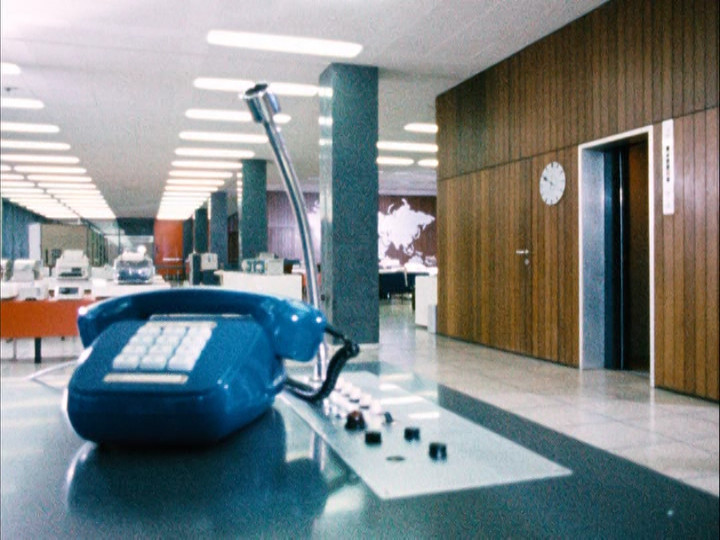
That is an unquestionable parallel to Mark picking up the phone. Also, we never hear the other end of the call Mark answers to. And since Mark is just a projection of Alex, this alludes to him talking to himself. In fact, Alex conveys this perfectly in the interview with Radio X while breaking down the Star Treatment music video:
“You almost see it as you’re right there with the narration. We would depict exactly what’s happening in the lyrics; eventually we end up in this car in the second verse. I’m in the front of the car, but who’s that ghost in the back? We began to explore this idea that it was me as well – and I’m talking to me’self.”
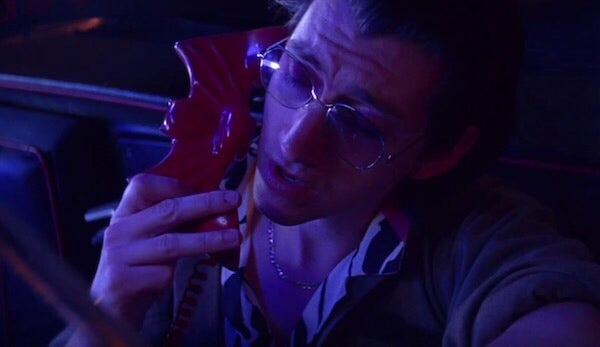
The word play between the verse and the chorus is also interesting. The lyrics, “where I ponder all the questions, but just manage to miss the mark”, are followed by Mark answering. I thought that was a clever way to convey the narrative.
The phone call Mark answers with, “good afternoon, Tranquility Base Hotel and Casino. Mark speaking. Please, tell me, how may I direct your call?”, could also be the signal from the real world to trigger his awareness of the false reality he inhabits, pulling him out of the simulation.
JEAN BAUDRILLARD
What is real? And how do we know it’s real? For the answers, I turn to French postmodernist philosopher, Jean Baudrillard. He believed our postmodern society is so reliant on signs and representations, it can no longer distinguish between reality and replicas of reality.
In his 1981 book, Simulacra and Simulation (which was also featured in the Matrix), Baudrillard critiqued the media’s impact on the postmodern world. He believed the dominance of media, catapulted societies into simulated realities, leading to loss of meaning, a detachment of self awareness, and the rise of commercial consumerism.
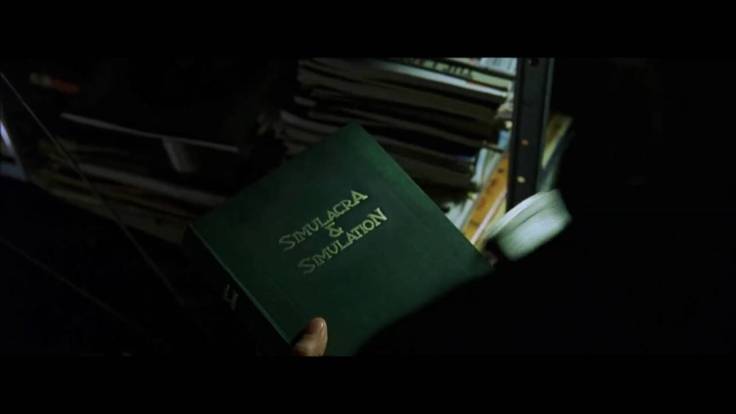
The images we receive through media consumption are first presented as mirrors of the tangible reality. What we see is basically a reflection of something we know to be real. The media then recontextualizes the meaning attached to the image. This manipulation is achieved through external marketing and advertising and our internal association to the image. This process leads to “hyperreality”, the simulation, where we are unable to distinguish reality from a false world. The real and the imaginary are intermingled. Keep in mind, this book was published in 1981. Social media and reality television are a perfect example of how symbols and signs have become self-referential, and not simply a replica of something real.
In the book, Baudrillard presents Disneyland as an example of his argument. He believed Disneyland was created in a way to make one feel as if they’ve left reality and stepped into an imaginary world. However, the world around this magical park is just as detached from reality. Disneyland mimics reality with its realistic streets and houses. But it’s still a real physical space defined and functioning through social constructs. There are expectations of behaviour and order in the busy world, there are vendors to purchase from, lines to stand in, streets and signs to follow, and the visitors inside this park, acceded to its “reality”. There is a very real exchange within this fantasy world. Baudrillard claimed people flock to this hyperreality, to Disneyland, believing they can escape the everyday, unaware that all aspects of the postmodern world are already detached from reality.
Tranquility Base Hotel and Casino is that escapist hyperreality. Here is an excerpt from my last article describing the album cover:
“The galactic complex is just a place the protagonist can escape to, and the clues were there all along to confirm this. The model of the structure on the album cover sits on a tape recorder. I believe the tape recorder is a reference to the missing Apollo 11 telemetry tapes which were a key element to the moon landing hoax conspiracy theories. The name “Tranquility Base” is the site on the moon where the astronauts landed. Right from the start, I believe Alex Turner is mirroring the fake moon landing narrative, warning us to not trust the reality on display. And I believe he took this directorial idea from Kubrick, who when asked about the alien narrative in 2001: A Space Odyssey, he stated, “this is what happens on the film’s simplest level.” In other words, things are not as they appear.”

We live in a hyperreality, and it’s becoming increasingly difficult to “wake up”, “log off”, or go “off the grid.”
Often in science fiction novels and films, there are “triggers”, or “totems”, acting as an anchor between the real world and the simulation. They aid characters, sharpening their awareness of their faux surroundings.
In Inception, Cobb carries a spinning top to reassure him of reality, in The Matrix, Neo is given “pills” to help him see the truth and navigate the simulation. Kubrick’s Monolith, Fassbinder’s mirrors, and Arctic Monkeys’ stage cube also serve as totems.
I’ve got the world on a wire
In World on a Wire, the paranoid project leader of the reality simulator program, holds a pocket mirror up to another character and anxiously states, “you are nothing more than the image others have made of you.” The architecture of the world the characters inhabit is embedded within mirrors and glass, and the characters’ images are reflected onto their surface.
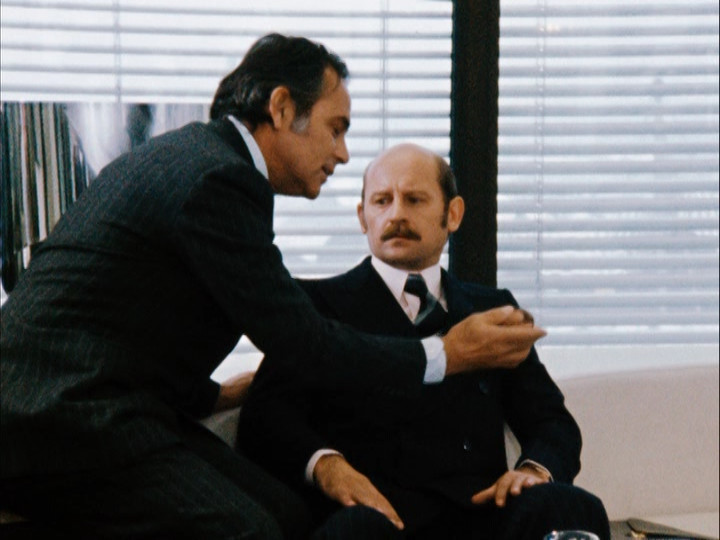
In 2001: A Space Odyssey, the Monolith triggers and accelerates human evolution when in contact with its glass-like surface. It consistently transitions beings into a new higher realm of cognition. In my previous article, I examined how Kubrick’s cyclical evolution inspired the reflective mirrored cube used by the Arctic Monkeys on stage.
I still stand by that, but I want to introduce another theory Alex may have borrowed inspiration from. In January 2018 Rocket Labs launched The Humanity Star into space. It is “a geodesic sphere, made from carbon fiber with 65 highly reflective panels, which spins rapidly mimicking a disco ball.”
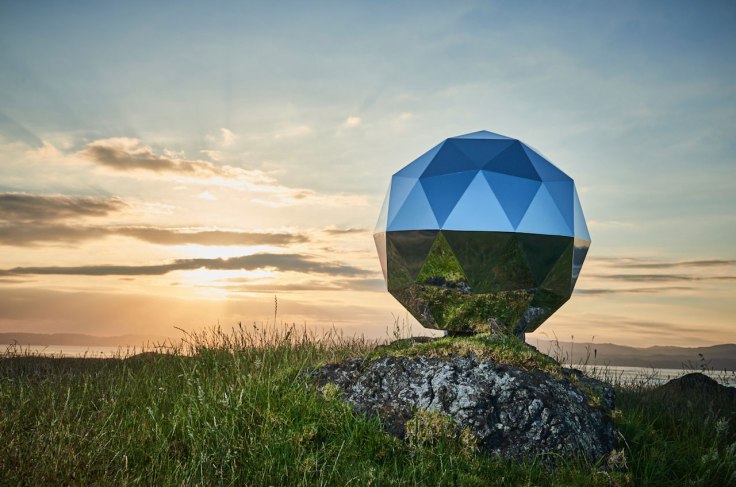
The humanity star launched in January 2018 but its design was known prior. The album came out May 2018 along with the tour. This timeline potentially aligns to when the stage was drafted and designed.
Rocket Lab founder and CEO Peter Beck claimed the Humanity Star was designed to be a “bright symbol and reminder of our fragile place in the universe.” Peter believed in the mission of the star. To inspire people to not only appreciate space but to reflect on their human purpose within our shared and collective existence.
The mirrored cube acts like a totem to guests of the hotel and casino triggering their own reflection of their purpose back on earth. He does repeat the mantra, “take it easy for a little while”, to address the fleeting escapist holiday.
Also the Humanity Star spun like a disco ball until it burnt out. Like a chapter coming to an end, which to me is the narrative of the album to follow, The Car.
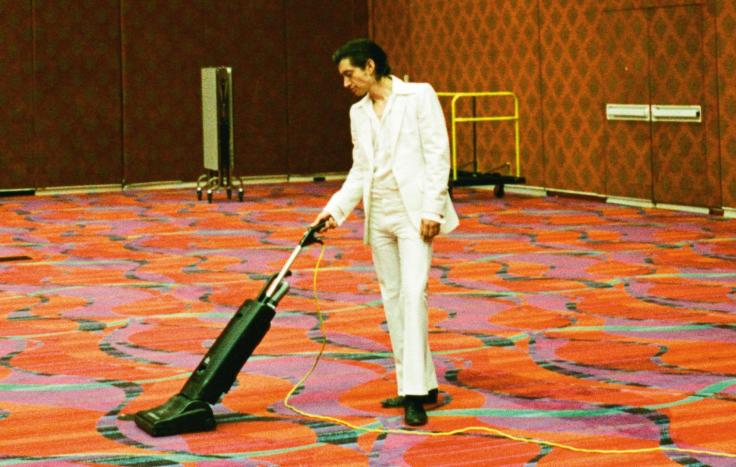
The last two albums are so deeply layered, I am still uncovering potential direct references or similarities I’ve found within other mediums like film and literature. Since my last lunar article I’ve come across a few more. For example, the image of Alex sweeping the hotel could also have been inspired by Mangon, the central figure in J.G. Ballard’s science fiction story, The Sound-Sweep. The story follows a mute boy (Mangon) who vacuums sounds in a dystopian future. The machines of this world create sounds destroying traditional music before it. Much like the use of synthesizers on the album. And like the narrative of the lunar album, it forewarns the impact of technology.
But the most fascinating missed observation, I stumbled on this week while reading an excerpt from Marc Augé’s 1992 book, Non-Places: Introduction to an Anthropology of Supermodernity. The few pages I found encouraged me to read the entire book, which was challenging and overflowing with concepts I will simplify here. The book elicited my newest theory: Alex may have modelled his simulation of Mark after the author, Marc Augé.
Tranquility Base Hotel and Casino, Marc Augé Speaking
Marc Augé was a French anthropologist who spent his younger years researching communities across Africa. His later years were focused on anthropological examinations of our human relation to contemporary spaces we occupy, time, and technology.
In the 1992 book, Non-Places: Introduction to an Anthropology of Supermodernity, Augé coined the term “non-place” (inspired by Michel de Certeau) to understand our relation to the modern world and its architecture, and how despite living in a space rapidly growing and inhabited by people, we are growing more unhappy and isolated. He urged the importance of studying our loneliness, a direct impact of acceleration in modern capitalism.
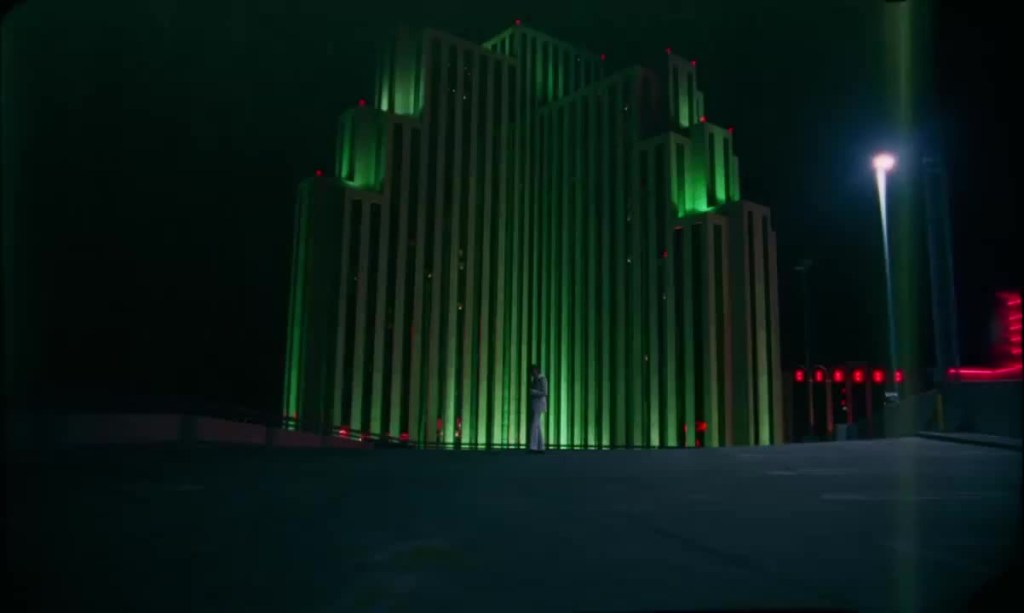
What is a non-place? According to Augé, a non-place is a transient space which we spend a majority of our daily lives in. It can be an airport lounge, subway station, gas station, supermarket, and–drum roll please— a hotel.
We don’t dwell in these spaces. We pass through them as anonymous and faceless individuals, which can lead to loss of our sense of awareness over time.
Non-places are essential to our daily functions but they’re banal in nature. Yet they are advertised as an exciting “collective” place. They offer the illusion of social settings and inclusion, like you’re part of something happening here and now. But they’re simply only a functional means to end.
These spaces tend to be uniform, devoid of identity and cultural history. We pass through them frequently yet temporarily. They don’t allow us to create relations, establish valuable communication, or build an everlasting attachment to them. They’re a temporary holding space with no historical narrative, so we can’t see ourselves reflected in them. And that sense of belonging these non-places deprive us of? It’s imperative to our communicative nature and growth.
Advertise in imaginative ways
In the book, Augé investigated the anthropological significance these spaces have on our modern world. He addressed the impact and negative consequences supermodernity has on the cultural spaces we inhabit, our communities. Supermodernity is the modern period of industrial accelerations, and the excess of information which he stated were responsible for creating the byproduct of our communities, the non-places.
Non-places are becoming prevalent in our society due to urbanization, gentrification, and globalization. They are saturated with advertisements and soulless commercial mantras, disconnecting us as a community and altering our sense of time and reality.
“Airline company magazines advertise hotels that advertise the airline companies; the interesting thing being that all space consumers thus find themselves caught among the echoes and images of a sort of cosmology which, unlike the ones traditionally studied by ethnologists, is objectively universal, and at the same time familiar and prestigious. This new cosmology produces effects of recognition. A paradox of non-place: a foreigner lost in a country he does not know (a ‘passing stranger’) can feel at home there only in the anonymity of motorways or big stores, service stations, and hotel chains. For him, an oil company logo is a reassuring landmark; among the supermarket shelves he falls with relief on sanitary, household or food products validated by multinational brand names.” – Non-Places, Marc Augé
Augé wanted to study the symptoms of the excess, to understand our human experiences. Likewise, Alex Turner addresses topics of politics, consumer culture, and rapid technological advancements on the metaphysical album to connect the listener to his music. Tranquility Base Hotel and Casino serves as a satire commentary on our social world and how the rise of the machines shaped our very dystopian reality. He said the following on Radio X:
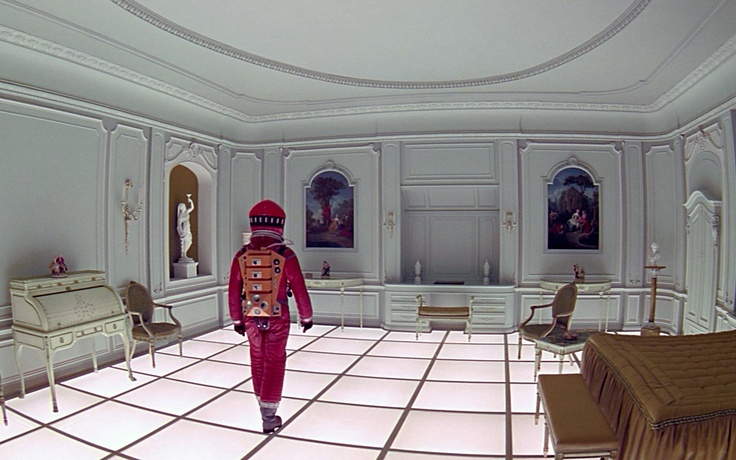
“The album artwork started from a picture that I saw of someone in the art department of 2001: A Space Odyssey, building the set for the Hilton on the moon. At this point, we’d already decided to call the album Tranquility Base Hotel & Casino, so we began to think of things that may be in the lobby of this place.The thing that I became most obsessed with was that there was a model of the place inside the lobby. That’s where I focused most of my attention and time, not figuring out what the place itself looked like, but what the model of the place in the lobby would.”
Examining the worlds of Augé and Baudrillard, I can conclude Tranquility Base Hotel and Casino hotel is a non-place, a byproduct of hyperreality.
White Safari Suit
With every album, Arctic Monkeys musically and physically mimic the style of the new world they inhabit. Alex wore a white safari-like suit on stage and in the music videos. A lot of critics and fans called the album the “70s” era record, drawing attention to the use of synthesizers and the band’s image.
Considering the topic of the lunar album, along with the epoch’s references, I would compare it to the start of the 1950s Space Age, leading towards the moon landing in the 60s.
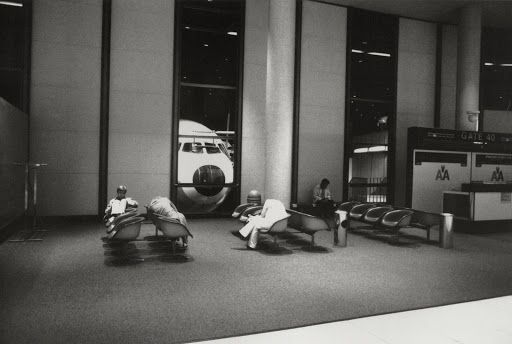
It wasn’t until I noticed the image on the cover of Augé’s book that I started to question the parallel between Marc and the avatar, Mark. Even though the book was published in the 90s, the image on the cover is of a departure lounge, from a series of 1960s and 1970s airport photos taken by Garry Winogrand.
The layout of the photo and the decor of the airport looks similar to the lunar world Alex created. Also the idea of departure into the unknown, launching into a new frontier, is reminiscent of the Space Age. But what’s striking is the central figure of the image. The figure is slightly out of focus and seems to be wearing a white suite similar to Alex’s 2018 costume.
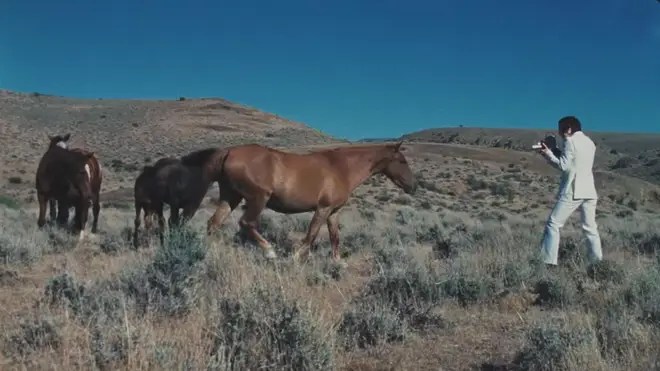
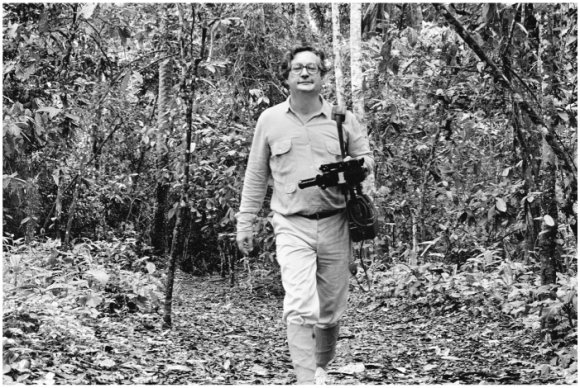
While researching Marc Augé, I found a picture of him in a similar full white, safari-like shirt and slacks, holding his cameras, while researching in Africa. The image is parallel to the clip of Alex with a camera, observing and documenting wildlife in the Tranquility Base Hotel and Casino music video.
However, I also think he may have borrowed the idea from the white uniforms in A Clockwork Orange.
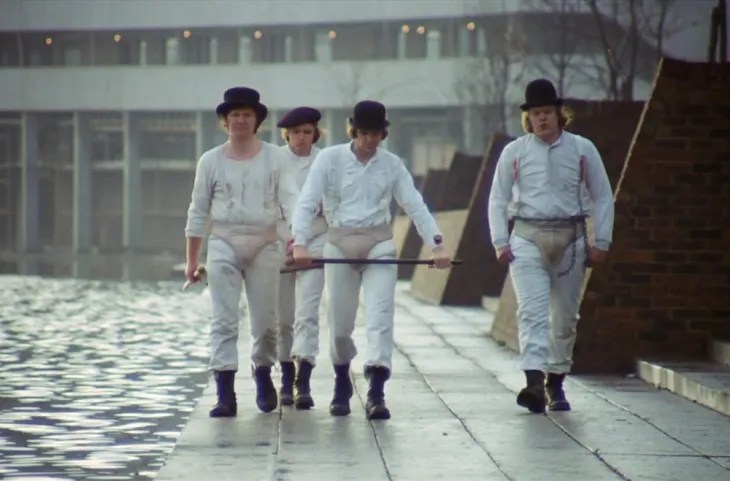
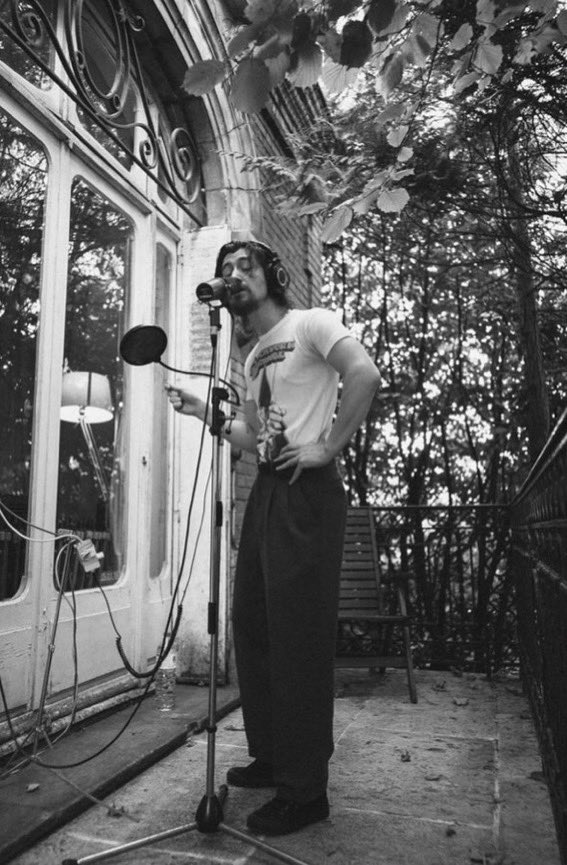
The Kubrick connection, the use of similar filming sequence (Alex, in the film, visiting the record store and Alex Turner walking around the hotel in Four Out Of Five) and the fact that he wore a t-shirt with the film poster on it in the studio and on casual outings, could also be a strong indication to the inspirational source of the white suit.
Alex is somewhat of a cultural aficionado, and he confirmed a lot of concepts he absorbed while working on the album, formed the narrative. Who’s to say he didn’t land on Augé while researching the album’s inquiries?
Elevator down to my make believe residency
Maybe Mark is the anthropologist of the lunar world. Like Augé’s hotels and terminals, Mark is surrounded by faceless and anonymous workers in matching red uniforms, as seen in the Four Out Of Five music video. They have no unique characteristics, just like the capitalist structures Augé writes about. Mark is surrounded by workers in an empty hotel, yet feeling alone and disconnected, a result of supermodernity. The search for meaning in Arctic Monkeys’ lunar world perfectly reflects the philosophy of Augé.

I leave you with the final quote from Marc Augé’s book:
“One day, perhaps, there will be a sign of intelligent life on another world. Then, through an effect of solidarity whose mechanisms the ethnologist has studied on a small scale, the whole terrestrial space will become a single place. Being from earth will signify something.”
Personally I think it sounds similar to the mission of The Humanity Star, inspiring people to reflect on their purpose within a collective. To form a connection in this modern world.
Marc reassures the reader of one day finding unity between non-places and places. To find meaning internally through external investigation of a world wrapped in modern excess and noise. Likewise, Alex invites us to explore his lunar world, navigating galactic colloquialisms, only to evoke a range of human emotions, bringing us back down to earth.
 SPANGLED CAVERN
You must be logged in to post a comment.