
“The Jeweller’s Hands and Catapult were the only tunes that had a central figure, this character of wisdom ” – Alex Turner on the band’s third record, Humbug. Source: XFm Interview.
I believe the true meaning of any song lives and dies with the artist. As a listener who enjoys Alex Turner’s syllabary Jenga, I can only attempt to connect the dots of his lyrics by projecting my own interpretations from my extracted experiences and literary parallels.
But what if there was a concealed code embedded, either deliberately or subconsciously by him, into a song within each album? A code serving as the totem and the key to unlocking the narrative of the album, setting the overall tone? One that wasn’t an interpretation, but a blueprint of his mind?
In this post, I want to discuss:
- How The Jeweller’s Hands exposes the semantics of Alex Turner’s internal dialogue, unlocking the narrative of Humbug
- Why Humbug is the sequel to Tranquility Base Hotel and Casino
- The central figure of both albums.
I assure you the parallels between both albums are correlative. I will be using examples from 2001: A Space Odyssey and World On A Wire to support my claims. But before I jump back into this analysis, I want to quickly reference the past.
CARTESIAN
Melodically, their previous albums, Whatever People Say I am, That’s What I’m Not, and Favourite Worst Nightmare, sound like straight forward indie rock records, peppered with ska, rock, and punk influences. Lyrically, they illustrate a Cartesian philosophical approach to how we acquire knowledge. They are riddled with skepticism.
Alex Turner mentioned in an interview that the first album was him “pointing at things” and talking about them. That may sound like an empirical approach, but his observations are not solely exclusive to his senses. In fact, the protagonist in both albums is constantly observing and rationalizing the world around him. There is a level of doubt in not only the lyrics but the title of the first album, “Whatever People Say I am, That’s What I’m Not.”
Personally, I prefer the parallel of Descartes and Arctic Monkeys in Perhaps Vampires Is a Bit Strong But. In the song, the band is growing aware of how many of the beliefs they held prior to fame were false. In the chorus line, “and though you pretend to stand by us”, the band is displaying an example of Descartes’ apple analogy.
Descartes was skeptical of the truth he held of the external world so he concluded everything was false and must be doubted in order to arrive at indisputable truth.
In his analogy, he imagined holding a basket of apples. Suspecting some were rotten, he decided the only way to remove doubt and to ensure the rot wouldn’t spread was to take out all the apples and examine them one by one, discarding the rotten ones. The first album lyrically used formal logic in removing doubt, the same way Descartes removed the bad apples to arrive at truth.
Descartes’ famous realization, “Cogito ergo sum” (I think therefore I am), allowed him to doubt the external but never his own mind. He was aware of himself as a thinking being. From there he was able to believe in “god” and the mathematical and physical world which built a rational foundation in search of truth and knowledge.
In Favourite Worst Nightmare, this is clearly illustrated through the song If You Were There Beware. The lyrics, “There’s a circle of witches, ambitiously vicious they are. Our attempts to remind them of reason won’t get us that far”, is an example of informal logic. The belief is deduced which I will analyze in a separate post. For now I want to return to Humbug.
HUMBUG
At the time of its release, I had a different reaction to Humbug than a loud majority of Arctic Monkeys fans. I knew what to expect from this brilliant album because leading up to its release, I was aware of Josh Homme’s influence, along with the psychedelic sound inspired by the desert recordings. Humbug is everything Descartes argued against. Empiricism is an epistemological theory that would look at the Cartesian theory and nod agreeing humans do in fact think. However, according to their theory, thought isn’t enough to arrive at the truth.
In short, to empiricists, we are born with a blank slate and our knowledge of everything around us can only be experienced and obtained through our senses. What I see, smell, taste, and touch is what is real. Our theorizing of the world doesn’t come from source, from a priori knowledge. It isn’t innate, like in the rational thinking of Descartes and the first two albums.
So who is “source”, the central figure in Humbug?
Humbug, which the band explained is a name of a candy that is “crunchy on the outside, but sweet on the inside”, has been described as a psychedelic rock album. The band traveled to Joshua Tree to record at Rancho De La Luna. Joshua Tree is a sacred place where the energetic fields cross in a vortex aligning our spiritual, mental, and physical properties. The band was isolated as a group, recording in a place of mystical significance. To amplify the mystique of their expedition, parts of Secret Door were recorded in the Integratron, an acoustically sound dome designed by ufologist, George Van Tassel. The spiritual dome is believed to rejuvenate our DNA, enable us to time travel, and is essentially an electrostatic generator.
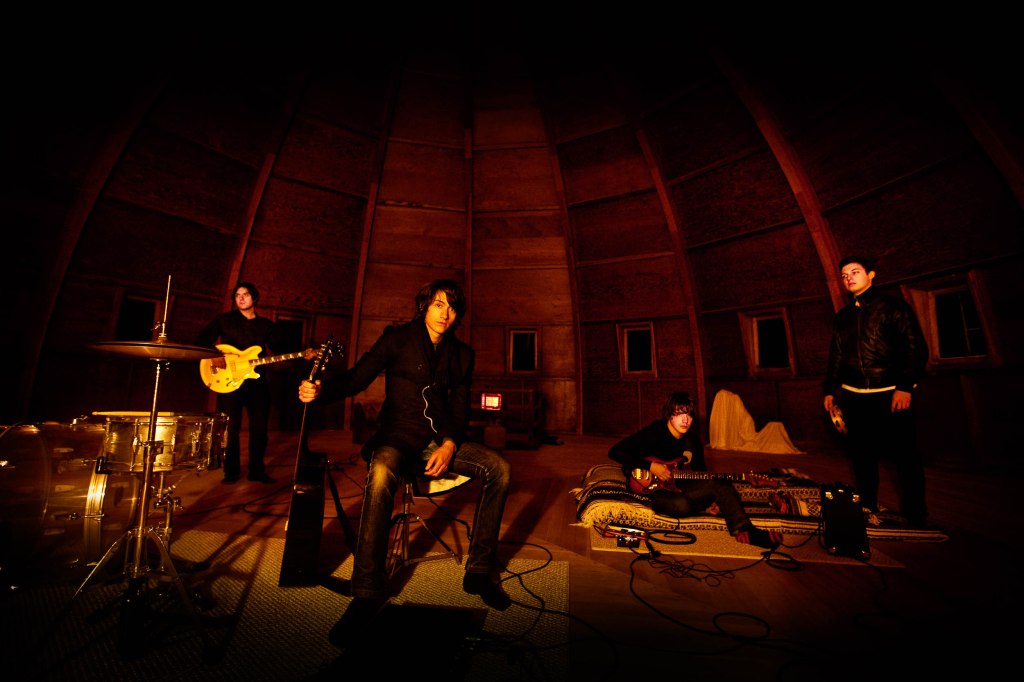
In my personal opinion, the Integratron is a cavern of sensory marvel, and perfectly embodies the essence of this album.
Alex Turner mentioned in an interview, during the Humbug promotional tour, that he put more of himself into this record. He used words like “personal” and “feelings”. And the lyrics indicate his feelings are created through use of stimulants, a complete sensory experience.
He also mentioned a central figure’s presence hovering in The Jeweller’s Hands. Due to the empirical nature of the album, I can only apprehend the central figure as an “unmoved mover”, a god-like entity. In some cases, a shaman or an oracle exuding prophetic wisdom.
In a linear timeline, Humbug is the third record by the band. However, reflecting back on it after the release of their seventh album, I’ve concluded Humbug is the sequel to the space inspired masterpiece, Tranquility Base Hotel and Casino. It is a self-reliant album, unlike its space prequel, which I perceive as an escapist device on its quest for utopia.
From my own experience, the pursuit for life’s meaning has taken many detours and formed into many shapes along the shaky terrain. I grew up in a religious household and as a result, I was presented with dogmatic answers to my profound questions. At a very young and impressionable age, I was shaped to believe in a finite set of laws, etched in stone by an unmoved mover, external to my existence.
My critical thinking walked a right rope of blind faith suspended over an uncharted world of blasphemous and disregarded inquiries. My badge of faith was strapped tightly upon my eyes.
These conditioned beliefs taught through tradition and religions are deeply rooted into our subconscious. It’s only through education, healing, growth, and a shift in perception do we unlearn these limitations and reflect on our experiences for answers.
Humbug was released in 2009. I was 26, barely standing at the finish line of my two year battle with cancer treatments, and at the start of my endless rounds of surgeries. Due to my frail immunity, I lived in confinement for most of my recovery. Three years prior to that and to my diagnosis, I completed my university studies in philosophy and the arts. My studies equipped my mind with a skeptic approach to the world around me. Questioning my own morality was the icing on the specious, post chemotherapy, congratulatory cake. The tone of Humbug, at my time of need, was the cherry on top. It was a reflection of my condition.
Right from the opening tune of the album, My Propeller reached for my hand and brought me down to earth:
“If you can summon the strength, tow me I can’t hold down the urgency. You’ve got to make your descent slowly. And oil up those sticky keys. Coax me out my low. And have a spin of my propeller.”
The narrative of the song is clear and simple. The protagonist has capitulated to his own sensory experience, stimulated by a substance, an object external to him. He relies on it assuredly to guide him through an unseen hurdle: his internal duality.
This is verified throughout the rest of the lyrics on the album, leading up to its closing tune, where the repetitive notion of the album’s “central figure” is finally given a name, The Jeweller. Which is why I believe this song holds the code in understanding the rest of the album.
THE JEWELLER’S HANDS
We meet the Jeweller in the second verse:
“You think excitement has receded then the mirror distracts. The logic of the trance quickly reaches and grasps. Handsome and faceless. And weightless, your imagination runs.”
I believe this is a god entity Alex Turner created out of either the figment of his imagination or encountered at Joshua Tree. I see that clearly in the phrase referencing the mirror. Anyone who has ever indulged in psychedelics knows the golden rule: Never look in the mirror.
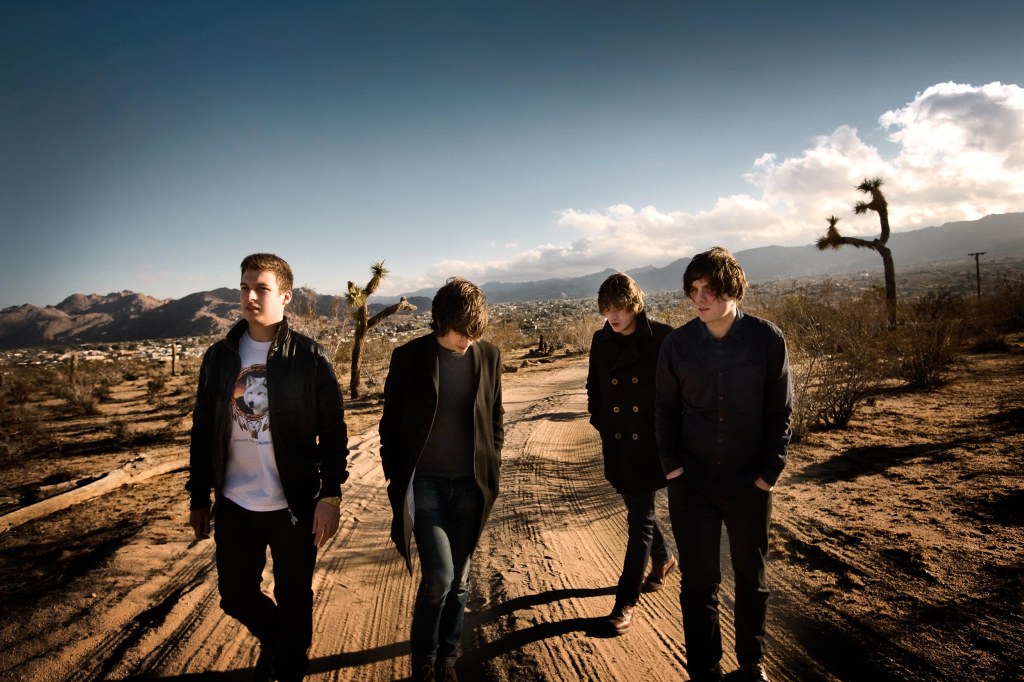
When I first heard the song, I thought it sounded playful yet sinister, like a carnival theme, which was also a word used in the opening line. This led me to infer the term “Jeweller’s Hands”, which represents a literal hand decorated with rings, like a carnival’s fortune teller, or an oracle. In other words, a god-like figure of prophetic prowess.
A central character found in this song is only one of the key elements shaping this theory.
Turning back to my philosophical claim of the empirical nature of the album, I conclude a different approach to the title’s meaning. Since the album exudes psychedelic themes and was recorded in a place of spiritual alignment, I believe the hand Alex Turner speaks of is the Hamsa. It is a hand shaped symbol and is worn as a talisman to protect one from negativity and evil. The word hamsa means five (Arabic and Hebrew). The five fingers on the hand symbolize the energy of our senses. Since I believe Humbug is an empirical album, where truth and knowledge is verified through sensory experiences, I can’t help but associate the symbol with this song.
During the Humbug tour, he wore a “praying hands” pendant. Unlike his other recurring pieces, the pendant never resurfaced.
There are other symbols found in The Jeweller’s Hands that fall into a code, unlocking the narrative of the album, further verifying my initial theory. Symbols of wolves, house of cards, and sinking stones. The lyric, “you thought the wolves would be impressed”, suggests an opposition but one residing within the protagonist. A duality. Wolves symbolize instinct or intuition, which opposes empiricism. In philosophy, Kant views intuition as a priori and not a sensory obtained cognitive concept. This inner duality is illustrated in other phrases like “sinking stone”, and “the house of cards”. There is a constant sense of instability, uncertainty, and insecurity in the narrative and within his own perception.
So the protagonist turns to the wisdom of The Jeweller:
“In the moonlight they’re more thrilling, those things that he knows.”
Keeping with the carnival theme, the moon in tarot decks represents illusions and self deception, not allowing ourselves to see nor accept the truth.
I find the lyrics, “watching his exit was like falling off the ferry in the night,” and “that procession of pioneers all drowned”, to be related. They paint a parallel image of followers led to their demise by their blind faith.
The protagonist’s search for meaning throughout the album relies heavily on his sensory experiences until The Jeweller’s Hands, which is the final track and the introduction to The Jeweller, the god-like entity.
“The inevitables gather to push you around. Any other voice makes such a punishing sound. He became laughter’s assassin, shortly after he showed you what it was”.
Returning to the theme of mysticism, the inevitables could also be a reference to Dungeons and Dragons. In the game, the inevitables are officially described as “constructs whose sole aim is to enforce the natural laws of the universe.” This could be in reference to the protagonist’s inner duality, fighting against his intuition and grasping onto the world he created through his senses. It’s less punishing, less stifling. The god-like entity descends on him illuminating truth, which puts an end to his search for it. But within the context of the complete album, this “illumination” comes at a price. There is a warning within The Jeweller’s guidance.
The battle between refuting a higher power and searching for answers elsewhere, is a consistent theme in both albums.
This is amplified towards the outro where the band repeats the phrases “if you’ve a lesson to teach me, I’m listening, ready to learn.” The line, “Let’s get it ingrained”, stands out the most. The protagonist is accepting the message from the god-like entity, welcoming its wisdom. He is giving up his empirical approach. The song hauntingly fades into an echo, similar to the sound of the sea in a seashell when held up to one’s ear, which confirms the protagonist, like the pioneers, drowned. Only he’s aware of his fate, the prolonged verdict to his truth.
The warning of religion is seen in Tranquility Base Hotel and Casino in the line, “Religious iconography giving you the creeps.” More on that later.
Earlier I wrote: “These conditioned beliefs taught through tradition and religions are deeply rooted into our subconscious. It’s only through education, healing, growth, and a shift in perception do we unlearn these limitations and reflect on our experiences for answers.”
Humbug challenges tradition and religion. It invites us to seek answers by looking inwards, navigating the external world through our human senses. However, the overall sense of melancholy throughout the album, and the submissive message to reality at the end of The Jeweller’s Hands, gives us a warning that we may not like the pending answer.

After the release of Tranquility Base Hotel and Casino, I personally found Humbug morphed into a new interpretation, enhancing its lyrical depth and philosophical significance. The parallel between the two albums is hard to ignore. The search for truth and our reality is the binding theme for both. Most profoundly, the search for truth orbits a central figure, a god-like entity.
Humbug is an empirical album which examines “how” we know what the truth is. It is a sensory exclusive experience. Tranquility Base Hotel and Casino is a metaphysical album. Metaphysics examine the nature of reality, and “what” is real. The approach to truth is different yet overlaps. Metaphysics defines the objects around us, and empiricism relies on our senses and reflection to explain how we reached the knowledge of the object.
Ergo Humbug is a sequel.

To elaborate on my theory, I have to look at our human condition. Through growth and healing, we are told over and over again to better ourselves, avoiding seeking validation elsewhere. Humbug deciphers the external world through subjective sensory reflections. Tranquility Base Hotel and Casino is an evasive album. It’s riddled with paranoia, themes of isolation, regrets.
When faced with problems, we escape. When we heal, we find peace within. The protagonist in the Tranquility Base Hotel and Casino album escaped earth to look for answers first, only to realize he needed to be grounded to evolve. Humbug, in the roster of Arctic Monkeys’ records, is the aftermath of his return.
PART 2: Tranquility Base Hotel and Casino
Tranquility Base Hotel and Casino serves as a satire commentary on our social world and how the rise of the machines shaped our very dystopian reality. It’s satire because a lot of the references, although accurately convey the current status quo, are quite whimsical.
For a theme of evolved technology and space travel, the lyrics are navigated through basic human emotions. It’s a metaphysical album searching for certainty in “what is real” yet evoking finite answers. And I’ve arrived at this conclusion because personally, aside from the galactic theme and colloquialisms, I find the lyrics of this album quite relatable.
Due to its metaphysical nature, the album not only asks what exists, but also how we know it does. And in relation to the album, does the hotel and casino actually exist?
Maybe it’s reflective of something he was facing personally at the time he envisaged it, or a commentary of the science fiction films he was watching, but he found a way to escape our world by creating a new immersive reality. He concealed himself into a concept album: “In the past what I was reading and watching seemed more like a way to escape from what I was writing” – Alex Turner talking to Steve Lamacq – BBC Radio 6 in 2018.
Personally I believe he wrote this album to reflect on his method and process of escaping his own reality. The album is an allegory. It is a multi-layered, behind-the-scenes revelation album. On the surface it’s a metaphysical narrative in search of answers, but it’s an illusion concealing his dismay. It reminds me of this quote:
“If you have built castles in the air, your work need not be lost; that is where they should be. Now put the foundations under them.” ― Henry David Thoreau.
Tranquility Base Hotel and Casino is his castle in the air.
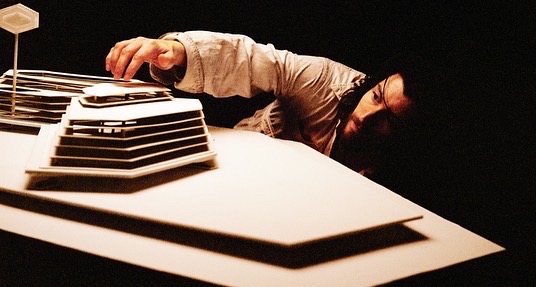
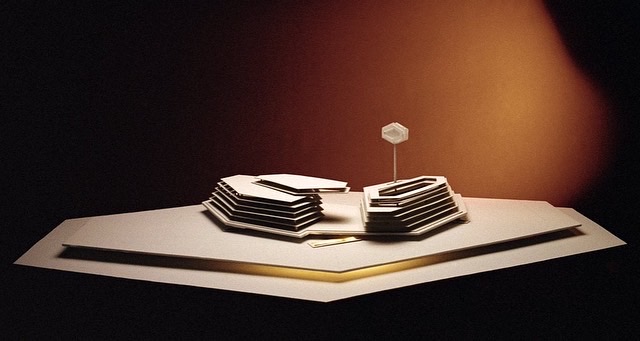
The galactic complex is just a place the protagonist can escape to, and the clues were there all along to confirm this. The model of the structure on the album cover sits on a tape recorder. I believe the tape recorder is a reference to the missing Apollo 11 telemetry tapes which were a key element to the moon landing hoax conspiracy theories. The name “Tranquility Base” is the site on the moon where the astronauts landed.
Right from the start, I believe Alex Turner is mirroring the fake moon landing narrative, warning us to not trust the reality on display. And I believe he took this directorial idea from Kubrick, who when asked about the alien narrative in 2001: A Space Odyssey, he stated, “this is what happens on the film’s simplest level”. In other words, things are not as they appear.
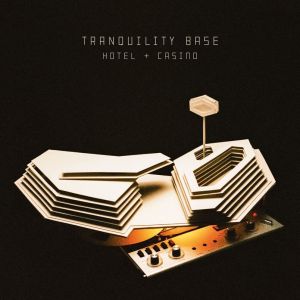
During the 2018 tour interviews, Alex Turner named key elements inspiring Tranquility Base Hotel and Casino. He was influenced by French and science fiction film, literature, soundtracks, set designs, and film production techniques. Although he listed various films, I believe there are two connections that are the key to unlocking the central figure of this album:
Stanley Kubrick’s 2001: A Space Odyssey and Rainer Werner Fassbinder’s World On A Wire.
All films, and the album, share a main narrative: The dark side of technological advancements. They also share god-like entities, much like Humbug. As I examined the central figures and their significance to the strange realities adhering to them, I felt catapulted into an infinite vortex of allegories.
Alex Turner writes, “Can I please have my money back? My virtual reality mask is stuck on “Parliament Brawl”, to illustrate the frustration and mistrust in the promises of a new Eden beyond our grasp. Kubrick conveys this through the brain of the spaceship, Hal 9000, who turns on its creators posing an ethical debate. Fassbinder illustrates fear and paranoia through worlds of simulations, blurring the lines of truth and reality. The worlds are immaculate in their advanced foundations, yet prone to human error.
THE MONOLITH
What is real? And how do we know it’s real? I found the answer for these metaphysical questions within Kubrick’s Monolith, Arctic Monkeys’ stage Cube, and Fassbinder’s mirrors.
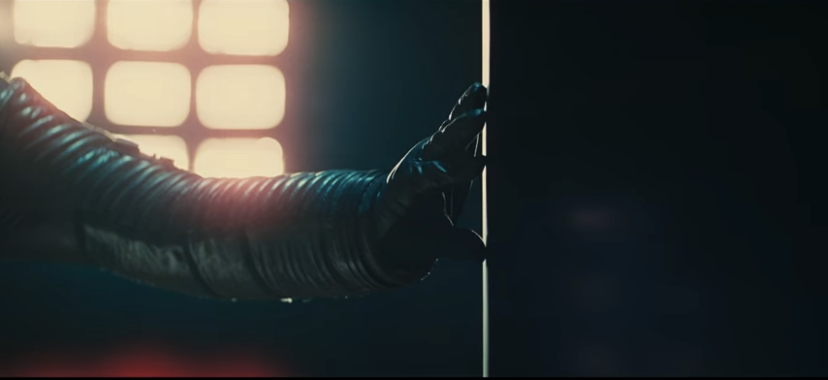
The Monolith’s origin comes from Arthur C. Clarke’s novel, The Sentinel. The alien artifact in the book was originally pyramid shaped, which was later changed in the film. Pyramids are metaphoric representations of death and the beginning (rebirth) of a journey into a new world. The Monolith was dubbed “the Firstborn” by the author, alluding to a world unknown to us. Therefore, the existence of the foreign structure is a symbol of both panic and reassurance due to its alien nature and the questions it poses of our beginning.
The internal dichotomies of these structures are a reflection of our uncertainty, not only within its highly advanced vicinity but of the reality surrounding it.
In the film, the Monolith triggers human evolution when in contact with its surface. It awakens a dormant intellect transitioning humans into a new higher realm of cognition. It also rewards humans with better tools to conduct their lives, which was seen in the opening shot of 2001: A Space Odyssey. The ape who touched the Monolith was rewarded with new tools to triumph.
This cyclical evolution inspired the reflective Cube used by the Arctic Monkeys on stage. I believe it conveyed the concept of their new sound (rebirth). The audience couldn’t escape its presence, facing it on stage. They stared at it while Alex Turner serenaded them with the new sound. He rewarded the audience with a visionary realm, to escape and “take it easy for a little while”. It’s as though he realized the band’s new music needed an extra “push” to evolve the listener who still stood stagnant in their former albums. The Cube was a tool to elevate the listener into the band’s next phase.
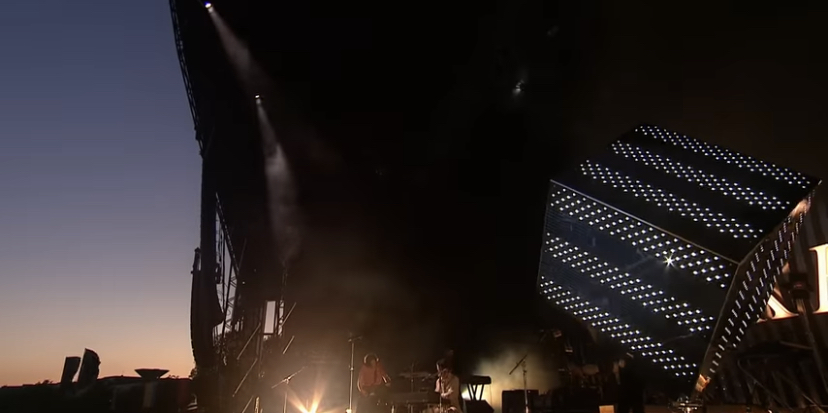
I can conclude that the stimulants used in Humbug, could also be classified as an evolutionary tool transitioning into the new era. The difference is, Humbug’s approach is tangible. The concept of the Cube is theoretical.
Fassbinder illustrates this differently. Right from the start of the film, the paranoid project leader of the reality simulator program, holds a pocket mirror up to another character and anxiously states, “you are nothing more than the image others have made of you.” When I heard that line I suddenly became more aware of the set design of the film. The rooms were lined with mirrors and the characters’ images were reflected onto their surface. I couldn’t escape the cinematography which served as a new allegorical immersive reality.

The world of Fassbinder is inside the Monolith. Characters navigate through realms within its non-existent walls. He conveys this in a brilliant scene that many people dismissed but I found to be pivotal to the plotline. The camera captures the protagonist, Stiller, opening a hallway door which leads into a replica of it, followed by another. This is easy to dismiss due to the conversation taking place at the same time off screen. To me, this represents the infinite simulation realities challenging the metaphysical plot of this film.
What I find most intriguing is the “trigger” sound, all these worlds share, including Humbug. And I’m not talking about music. In World On A Wire, whenever the protagonist comes close to “breaking through” out of the simulation reality, an alarm sound goes off. The sound is emitted from within him because he is in fact a computer simulation being controlled in the real world. The sound doesn’t just serve as a warning to the viewer, but also as a shift into the plot. The closer he gets to breaking through, the further away he is transitioned in his progress of escaping. Whereas the Monolith pushes forward, Fassbinder’s world pulls us further in.
In World On A Wire, when the sound is accompanied by a flashing red light, the characters were approaching truth, an exit of the simulation. This can be seen at the start of the Four Out of Five video, where Alex Turner walks through the corridor into the bright room where his model sits, away from the red lights. It’s seen again as his beardless twin walks towards the flashing red lights. I believe the duality of the two characters represents more than an aesthetic adaptation of World On A Wire.
Maybe it’s his internal struggle of wanting to escape his reality avoiding the inevitable fate awaiting. What his fate or the problem is or was, is a projection of his personal life and one not accessible to the listener. The same lights and sound can be seen and heard in a transitional shot of the Tranquility Base Hotel and Casino video, extending the narrative.
Arctic Monkeys used the same technique to open their 2018-2019 tour. Many have linked the sound to a generic science fiction reverberation, a warning call. It’s hard to dismiss the urgency in the sound but I don’t believe it’s sinister. I believe it’s necessary to trigger the world “jump”, the new reality where we are evolved versions of ourselves. I think they used the sound on tour, along with the Cube, to signal the shift in the band, opening the new gate or vortex into the evolved version of themselves.
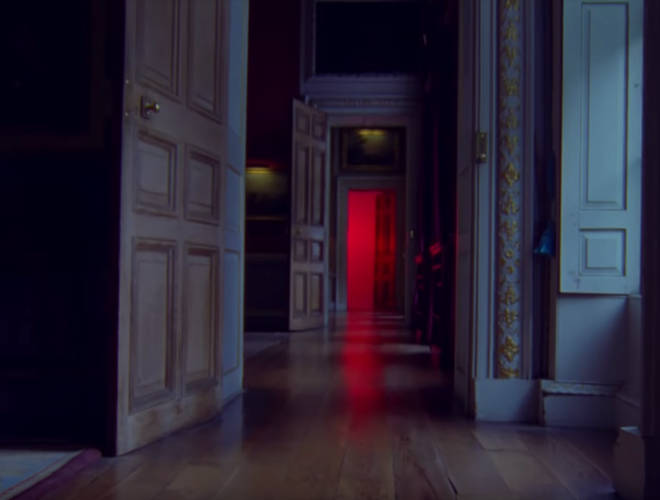
This same sound is heard in Humbug’s Dangerous Animals, which in a separate post I’ve described as a Nietzschean theme, and the introduction to Dance Little Liar right before the opening lyric, “I heard the truth was built to bend.” Here the protagonist is aware of their false reality.
Kubrick’s Monolith also produced a sound, although it was different, it triggered the new evolutionary shift and the journey into rebirth.
The Kubrick connection is hard to ignore, so let’s look a little deeper into the score of the film for 2001: A Space Odyssey. Richard Strauss composed Also Sprach Zarathustra in 1896 which was inspired by Nietzsche’s work of the same title. This musical composition is called a tone poem because it is one continuous piece structured this way to narrate a story. It’s intended to make the listener conjure up or remember images, novels, and places while listening to it.
To me, Tranquility Base Hotel and Casino is a tone poem. The album’s songs not only blend into each other, but they immerse the listener into another world. It gives the audience a location, a place to escape to.
In a post on my Instagram, I drew a connection that wasn’t premeditated and it blew my mind. Alex Turner was born in 1986, Richard Strauss composed Also Sprach Zarathustra in 1896, and Kubrick released 2001: A Space Odyssey in 1968. The rearrangement of the numbers isn’t the only strange coincidence. In Nietzsche’s novel, Zarathustra speaks of eternal return, or recurrence. The theory claims everything in existence has been and will continue to reoccur infinitely through time and space.
This is evident in Kubrick’s film and Turner’s work. In a linear timeline, Tranquility Base Hotel and Casino was released in 2018, nine years after Humbug. However, I believe regardless of its placement, it is the prequel to Humbug.
THE PREQUEL
In 2001: A Space Odyssey, there are three parts to the film: The Dawn of Man, Jupiter Mission, and lastly Jupiter and Beyond the Infinite (the rebirth). I’ve broken down Tranquility Base Hotel and Casino into three sections as well:
1: Start Treatment, One Point Perspective, and American Sports.
2: Tranquility Base Hotel and Casino, Golden Trunks, Four Out Of Five, The World’s First Ever Monster Truck Front Flip.
3: Science Fiction, She Looks Like Fun, Batphone, and The Ultracheese.
When viewing the album and the film in this perspective, the rebirth of astronaut Dave, the Starchild, aligns with the first song on the album, and the birth of a new Arctic Monkeys era. Star Treatment is the rebirth of the protagonist, and with the opening line “I just wanted to be one of the Strokes”, we understand this album is a self-reflective diary, a captain’s log. Alex is the main character, the captain of his spaceship, on route to Tranquility Base. Where Kubrick ends, Alex Turner begins.
Right from the start, we are catapulted through Kubrick’s stargate, and are called to evolve into a new era, just like Dave was.

Section 1 of Tranquility Base Hotel and Casino starts off with the character evolving into a new advanced world. But it ends with American Sports, a track of the protagonist reflecting back on earth yet aware he’s not in space. “My virtual reality mask” is the first line on the album hinting at a simulation. “Just in time for my weekly chat with god on video call,” is one of the most important statements on the album revealing the central figure. I will discuss it later.
Section 2 of the album holds the totem of reality. It is an acceptance of the simulation and his new character role, which I will discuss later on as well.
Section 3 is the revelation and exit. Just like The Jeweller’s Hands, Science Fiction is the key to understanding the album. The opening lyric, “Religious iconography giving you the creeps,” is the warning of the inevitable demise the world he constructed to escape reality could bring. Humans are prone to error and to digress from their evolutionary advancement by resorting to myth and religion. Affirmative foundations of subjective comfort rather than objective critical proof.
The rest of the tracks are a return to human emotions. He’s allowing himself to feel love and to remember the mundane daily activities with “her” in She Looks Like Fun. Finally it ends with The Ultracheese, a nostalgic song of loneliness and regret.
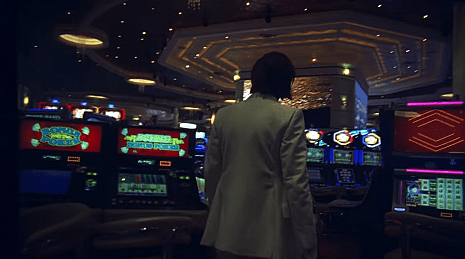
Where does Humbug begin? The Ultracheese, the closing tune of Tranquility Base Hotel and Casino, seamlessly falls into the opening lines of My Propeller. He ends the album, reaching for the nostalgic parachute of his past to help him descend to earth. With the lyric, “still got pictures of friends on the wall,” he is longing, remembering, and in a sense coming back down to reality, motivated by his basic and unavoidable human instinct, love.
Right after his return, Humbug steps in as a sequel, with the opening line, “If you can summon the strength, tow me.” To make sense of his reality, without escaping it externally, he is reaching for a stimulant to help him observe the world he’s in, decoding it through complete sensory surrender.
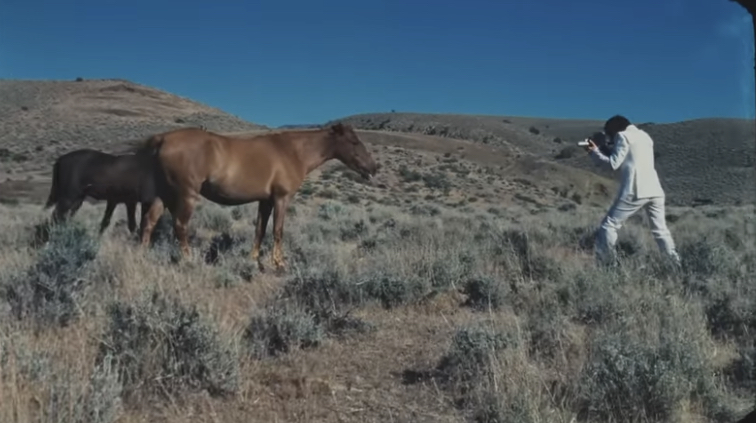
He never went to space. He escaped the world only to return. This can be seen in the Tranquility Base Hotel and Casino video. The hotel and casino are always empty. A place the band repeats was given a “4 out of 5” star rating yet consistently looks vacant and isolated. The hotel and casino are a vessel. They’re always empty alluding to a clean slate, or what I believe to be a clean slate of our psyche. The complex conveys secrecy, isolation, and self-reflection.
There is footage of him recording horses with his vintage camera. This image evoked my first doubt of the reality he’s immersed us in. He is recording this footage on the moon, therefore a horse in the sky is a symbol of Pegasus, the mythical flying horse. Pegasus was eventually turned into a constellation by Zeus. The mythical horse is also another reminder of the fiction unraveling before our eyes. It’s not real.
DUALITY AND SURVEILLANCE
In the Four Out Of Five video, we get our first glimpse of two new themes: duality and surveillance. Duality is felt in the rejection of technology and the consumer culture by the questions posed through the lyrics.
The protagonist’s internal dialogue is a constant battle between new and old. The term Luddite refers to a person opposing new forms of modern technology. One who views the new world order responsible for our growing pains, paranoia, isolation, and loss of personal privacy threatening our autonomy. In Tranquility Base Hotel and Casino, this is clear within the context of the lyrics refusing to divorce us from our human condition. There is a pending warning embedded within the album doubting its simulated reality.
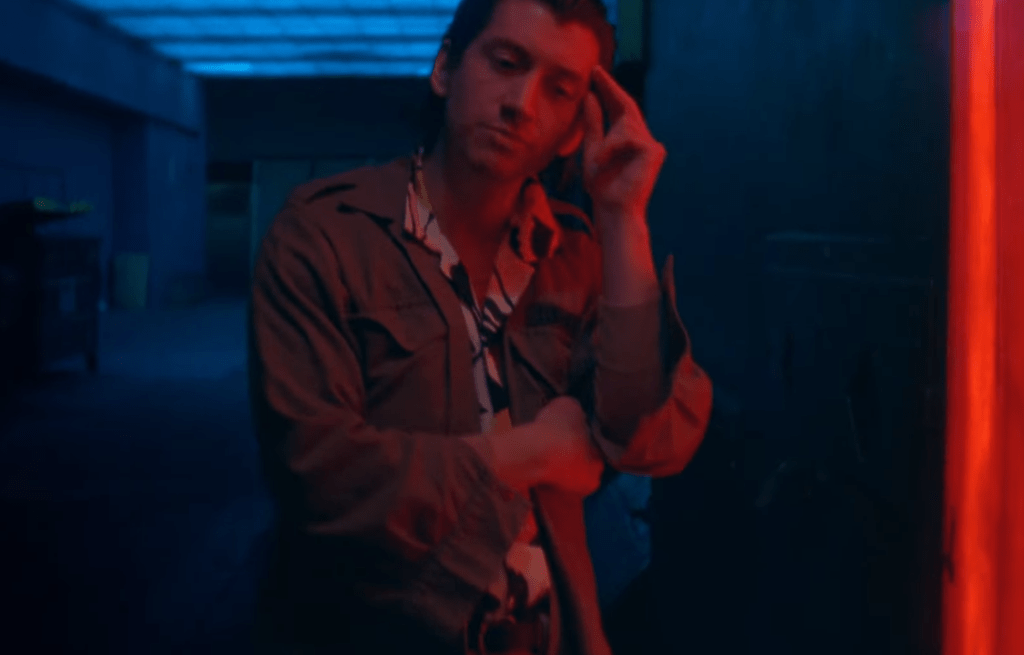
The Four Out Of Five video was released in May, and the video for Tranquility Base Hotel and Casino followed in July. There are two versions of Alex Turner in the Four Out OF Five video. The same versions of him can be seen again in the next video. A sequence of shots where he’s looking over the model structure on his desk, seamlessly fade into each other, illustrating a parallel world. World On A Wire inspired the stylization of the Four Out Of Five video, and possibly his writing themes of government formed simulations, parallel worlds, AI, paranoia, and consumer culture.
The subject of surveillance is tied to the central figure, watching over the worlds created. I believe both 2001: A Space Odyssey and World On A Wire, not only inspired Alex Turner to create a parallel universe he can escape to, but their narrative shaped whom I believe to be the central figure, the god-like entity: Mark.
MARK SPEAKING
I believe Mark is a projection of Alex Turner in the world he created. He is the central figure and god of the Tranquility Base Hotel and Casino world, until he experiences a human error, “triggering” an alarm to sound off for Alex Turner, enabling him to exit the false reality he created.
To understand Mark better, I have to take a look at the films mentioned. In 2001: A Space Odyssey, Hal Is an AI robot with consciousness. Dave’s character is quite bland in comparison. This was intentional to make Dave relatable to the audience, allowing us to embed ourselves into the plot. Because Hal is the “brain” of the ship, and because he can function without the ship in a different vessel, I believe he is a central figure, a god. He watches over the occupants of the ship as if they lived in a miniature model. He grows more aware of himself as the plot develops forcing him to act immorally to save himself from destruction. This has sparked many debates questioning the nature of Hal’s morality and judgment. I personally don’t believe he’s the villain of the story. He is a projection of our desired evolutionary state, which I believe Dave becomes after his own death.
In World On A Wire, “the contact”, is the only character aware of its world and the simulation it’s in. The contact can also occupy bodies of different characters, shifting its reality and entering various simulations. The contact is the central figure of the film because on quote, “without it, the simulation program can not run.” Just Like Hal, the contact is aware of itself and can direct the protagonist through the plot line. It can occupy other bodies and serves as a beacon and a guide, redirecting others.
The simulation world the contact lives in is the mirrored world I mentioned earlier. The simulations inhabiting the world are projections of themselves. The contact seeks to control reality and manipulate the simulation to escape it.
In the film, the first contact, Einstein, lives in a hotel. When the protagonist is sent through the computer to speak to him in search of truth (like an oracle), he must be signaled back to “reality”. He does so through a phone call.
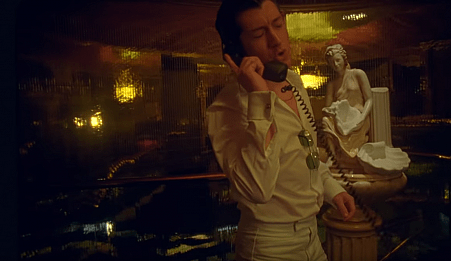
I couldn’t help but draw the many parallels between Mark picking up the phone at Tranquility Base Hotel and Casino, and Einstein, a dweller of the hotel lobby. We never hear the other end of the call Mark answers to. Mark is just a projection of Alex. He is talking to himself.
This had led me to believe the phone call Mark answers with, “Good afternoon, Tranquility Base Hotel and Casino. Mark speaking. Please, tell me, how may I direct your call?”, is actually the signal from the real world to trigger his awareness of the false reality he inhabits, pulling him back to earth.
In the film Inception, characters carry Totems to help them navigate through the many realities and steer back home. The title track, Tranquility Base Hotel and Casino is the totem of Mark (Alex), and the listener.
The reason I placed the song in the second section of the album is due to the duality it faces. The verse “I’ve been on a bender, back to that prophetic esplanade. Where I ponder all the questions, but just manage to miss the mark,” let’s the listener understand that the protagonist is aware of the simulation world and his existence within it. He knows he can’t find answers to his inquiries by avoiding them in this world he created.
And the lyric, “This magical thinking, feels as if it really might catch on,” confirms to the listener that he’s not willing to leave yet. His delusional naive thinking is still hopeful.

And finally, “And do you celebrate your dark side? But then wish you’d never left the house?”, supports my theory of escapism. I believe the dark side he’s referencing is the dark side of the moon, which faces away from earth. He turned his back on earth, on reality, and built a world inside of his mind that trapped him within its finite limitations.

I strongly believe Mark is a projection of Alex Turner. He is the higher evolved simulation of him. When Alex Turner embarked on this metaphysical album, I believe he became enthralled by the process of writing and creating this new world, a concept he’s never conceived before as an artist. And maybe along the way, the lines between the worlds blurred. Where we see one version of him walking towards the red lights and further down into his psyche, we see another within the same music video walking away, exiting the simulation. I believe this was Alex Turner giving us a behind-the-scenes glance at his writing process for the album. His contrarious internal dialogue.

Note how the bearded older version of him walks away from the red lights to stand over the lunar complex model. I believe this is Alex Turner’s version of Cinéma vérité. Not only is he turning the camera onto himself, the director of the reality we are watching, but he’s giving us a glimpse of the truth. I personally believe this version of him is in the real world, on earth. The clean shaved, sharply dressed version of him, reminiscent of the AM era, hovering over an impeccable complex, a literal castle in the sky, walks into the red light voluntarily falling deeper into the simulation. This is Mark.
In World On A Wire, one of the characters prophesied to the protagonist the simulation he’s in: “Everyday you reign like God. Over a miniature world you helped to create, and which you mistake more and more for a real world.”
Jupiter and Beyond the Infinite
The final section of the album is the crumbling of the world he created, and it starts off with Science Fiction. I’ve listed above the meaning of the opening verse and the error of mankind relying on religion to evolve. But I find he is struggling to exit the simulation he created through this verse:
I must admit you gave me somethin’ momentarily
In which I could believe
But the hand of harsh reality’s un-gloved
And it’s on its way back in to scoop you up
But not on my watch
I wanna stay with you, my love
The way some science fiction does.
There’s that duality again. In the second section of the album, he is aware of Mark as a projection of himself, but he plays along and even invites us to join his delusional utopia as he gleefully states, “Come on in, the water’s lovely.” And he even embraces the technological world with the lyric, “you push the button and we do the rest.” This also was an advert slogan for Kodak, “You Press the Button, We Do the Rest.” It’s a statement of awe towards the very world that would inevitably destroy him.

In the third section, his views on the consumer world and himself as a byproduct, changes with my personal favourite verse from Batphone:
Life became a spectator sport
I launch my fragrance called “Integrity”
I sell the fact that I can’t be bought
Have I told you all about the time that I got sucked into a hole
Through a hand held device?
In the first part of the verse, he’s making a statement of himself and the simulations around him. I think this is a personal projection of the time he spent in LA and how he’s aware of it tightening its grip on his authenticity. This is a process every artist faces, the cliche tale of Tinseltown and the artist, or David and Goliath. The second part of the verse, he’s speaking of the world he tried to escape, only to run into himself and the limited finite ideas within the simulation. It can also be a reference of our mobiles as Monoliths.
The songs in the third section of the album are placed between the beginning of the end, Science Fiction, and The Ultracheese. I can’t mention World On A Wire, without the direct verse:
Got the world on a wire
In my little mirror, mirror on the wall
In the pocket of my raincoat
I have to admit, this entire post was inspired by that verse. It was the one exposing the central figure and the narrative of Mark and I couldn’t have theorized it without the scene I’ve discussed earlier of Vollmer holding the pocket mirror. I believe Alex Turner is the main protagonist of the album, not a character he conjured. And the mirror he carries in his pocket is directly linked to two lyrics and two different concepts.
The first one is in American Sports, “just in time for my weekly chat with God, on video call.” In his world of false reflections and projections, he opens the mirror in his pocket to talk to Mark, his own reflection. “Mirror Mirror on the wall,” is a reference to the queen in Snow White talking to the oracle in the mirror. An oracle of wisdom who can see into other worlds. Mark is the god-like central figure, his own creation. The concept of the god-like entity in the “mirror” is also mentioned in The Jeweller’s Hands which I discussed earlier.
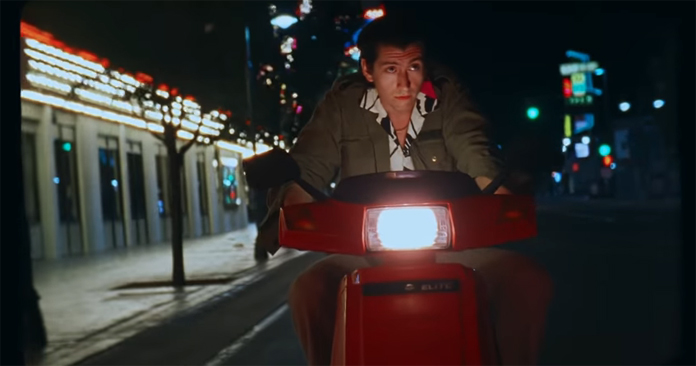
The second concept is within the meaning of the first line. World on a wire could also mean a computer. A world running on a signal. This leads me back to the only lyric Mark utters, “Good Afternoon. Tranquility Base Hotel and Casino Mark speaking Please, tell me, how may I direct your call?” Alex Turner could be reaching for a metaphoric mirror, a reflective monolith in his pocket: His phone. He’s calling Mark, himself, pulling him out of the simulation just like in Fassbinder’s film.
In 2001: A Space Odyssey, Hal develops human emotions which leads him to err in his discoveries. Wanting to survive, he goes after the crew but ultimately it leads to his death. In World On A Wire, Stiller must stand up against the simulation and accept his exit. The contact was compromised, and the simulation world was corrupt. With The Ultracheese, the end of the album, I envision the protagonist realizing he couldn’t escape himself. The simulation isn’t as evolved as he hoped because it was driven by a human oracle, a flawed central figure, a projection of himself.

FINAL ORBIT
The album’s b-side track, Anyways, is the final orbit before landing back to earth and into Humbug: “Just another microcosm somewhere in the ether”. He realizes his inquiries can’t be solved and he returns to earth:
Devising methods to both have and eat your cake
Mmm, just like the ones that Mother Nature used to bake
You look as if you know exactly what I’m gonna say
Is just another race to
Anyways
Leaving the metaphysical world behind, he comes back to mother nature with a blank slate, trusting his senses to find answers. He wakes up in this reality, defeated, left with many unanswered questions. Brooding, he reaches for an earthy simulant to coax him out of his low.
 SPANGLED CAVERN
Ummmm this was beautifully written & such an interesting article to read! Reading this inspired me to get back into my own creative writing, thought processes, and indulging of the human psyche; it also reaffirmed the personal fascination I’ve always had with this band…specifically Turner & his lyrics. Thank you for writing this analysis so in depth & detailed. It’s nothing like I’ve ever read before & motivates me to continue existing in the ethereal & metaphysical worlds…and maybe talk more about it too. :,) hehe
LikeLiked by 1 person
This absolutely made me so happy to read!!!! I love this part of the fandom where it comes down to human connection. I’m so glad I can build a bridge between us and the words where we can meet. Thank you for taking the time!!! I really am so very appreciative of this.
LikeLike
First of all, I absolutely love this. The way it absolutely makes sense but I would have never in a hundred years been able to come up with all of this. Impressive. I hope you don’t mind but this rant has to get out. I was very excited to read this post, since TBHC and Humbug are my favourite AM albums and the notion that they are directly related intrigued me. The deep insight into The Jeweller’s Hands also thrilled me, it’s one of my favourite songs ever by them. Might be the most mysterious song I have ever heard and I have been trying to figure it out since I have first heard it. Other interpretations (the song being about an affair etc.) I have read I have also found interesting but never quite satisfactory, but this one, wow.
“Humans are prone to error and to digress from their evolutionary advancement by resorting to myth and religion. Affirmative foundations of subjective comfort rather than objective critical proof.” This made me think of the Dialectic of Enlightenment
which suggests that enlightenment has been taking place since the beginning of mankind and that myth is already enlightenment and that humans will inevitably keep going back to mythology. TBHC definitely deals with that and the way technology has a certain religious quality that is a manifestation of the human desire for larger, deeper truths and a god-like figure.
Loved this post so much and I am excited to see what’s more to come. Can’t wait to have my mind blown again.
LikeLiked by 1 person
I swear I replied to you (or may have on IG). Thank you truly for reading this and taking the time!!! I think I may have replied to you on IG? Hahaha if not I’m so sorry.
LikeLike
Yess, that was me hahaha
LikeLike