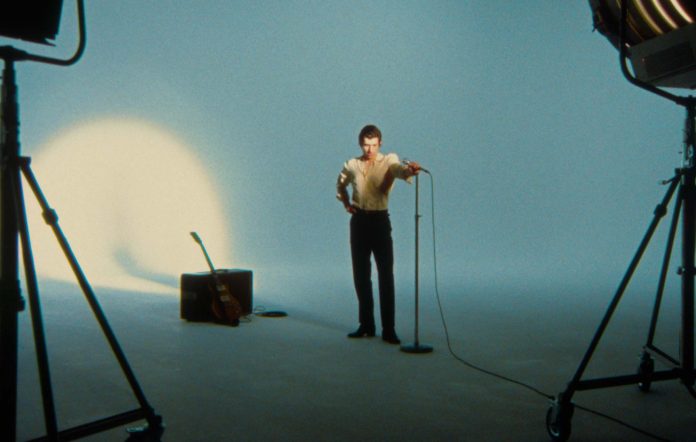
I have been writing the second part of my Body Paint video theory for the last week (mostly due to my chaotic work schedule). Two nights ago, an official analysis was released by the director, and I was happy to see we had two similar aligned overall concepts: Film making and nostalgia. Otherwise, I love his technical breakdown and I learned a lot of new concepts.
My analysis is slightly different and could be completely off, but I think it would be fun to share it regardless of what has been confirmed.
—————-
Let’s talk Godard.
Jean-Luc Godard: “There is no difference between image and sound. They are tools and sometimes you have to listen to the image and to look at the sound.”
This answer was from a question posed by Dick Cavett in regard to Godard layering opposing sounds to a scene or allowing the audio from one scene to leak over the next frame. Godard goes on to say “the audience has to do something. The audience should think, they have a responsibility in the making of the movie.”
It’s hard to ignore the influence of La Nouvelle Vague, French New Wave cinema, and 70s paranoia trilogy work of Gordon Willis in the Body Paint video.
Let’s backtrack a little. Back in 2006, I graduated from Art History Criticism and Gallery Studies, with a minor in philosophy. And even though that was light years away, the inquisitive cognitive tools I’ve acquired have never left me. As someone still very invested in the arts, personally, it was impossible to miss the transparent and familiar striking images in this video.
First there was the overall thematic style. If I had a word to describe the theme, it would be anachronistic, which is actually how I would describe time traveling Alex Turner in general.
There were strong elements of early Godard and the French New Wave cinema in this video. They were fused with avant-garde experimental films, mixed in with retro 80’s MTV features, stirred with Neo-Luddite philosophies, and peppered with the robust sentiments of nostalgia, especially those found in 70’s film.
Then there were the direct references. René Magritte’s Son of Man paired with the crop duster aircraft landing towards him, echoing Hitchcock’s North by Northwest. Two different mediums, fine arts and film noir inevitably colliding. And of course, the vibrant finale of the spinning zoetrope-like room, reminded me of Kodak’s Carousel and an earlier Instagram post I made in reference to a scene in Mad Men.
In the episode, Don Draper is assigned the task of producing a marketing campaign for Kodak and their prototype, “the wheel”. He renamed it the Carousel and created an ad based on nostalgia, placing emphasis on our sentimental bond with the product that goes beyond its technical purpose. In this case, our emotional bond with the rotating images on screen that goes “beyond the flash.” An almost behind the scenes look on one’s past.
On one hand, the Body Paint video reads like a Lyric Video, serving its technical purpose. The relevant images coincide with the words. To the point and precise. Until it shifts into a series of stylized images that don’t correspond to the lyrics. Some are incomplete concepts, visually awaiting the queue of stage production. In particular, the use of the street hazard signs paired with the Steenbeck flatbed in the editing room. Their presence makes us aware of the film we are currently viewing. We recognize it’s a work in progress and in production.
Watching the Body Paint video within this context, corroborates the given theme of the album: Cinema. However, what we are witnessing on the screen is anatomized. We, the audience, are therefore being immersed into the production room and with the film crew and actors. We are not only watching but are participating behind the scenes. Which reflects back to not only Godard’s claim of our responsibility as spectators, but also to what Brook Linder stated.
I was over the moon when I read Brook’s response because it aligned perfectly with my main overall theme of this analysis:
“Body Paint is very much about visualizing the process of film making.” He then continues to say. “There is a code to be deciphered and everything has a specific meaning, but mostly It’s the code making itself that’s on display.”
This takes me back to Godard. Creating film is not only his calling, film plays a vital role in the lives of his characters. His film Le Mépris is about filmmaking. Much like Tim Burton’s Ed Wood, Federico Fellini’s 8 ½, to name a couple. These films are a great example of “code making on display”.
Godard’s jump cut methods manipulate time and make you aware of the film’s physical presence, an example of code making on display. He also utilized this method to visually channel the emotions of his characters to the audience.
It wasn’t only the cinema on display. It had all elements of creative design fused and layered onto frames, characters, and scenes. Godard’s characters would reference visual arts, comment on pop culture, consumerism, and they would read excerpts from influential literature to illustrate a point, or to quote Brook “to decipher the code.” This method offers a channel to the narrative even if the narrative conveyed contradicts the nature of the theme.
This method is evident in Body Paint. The band is also filmed moving the lights on the track. They are playing their own role within the production. Godard broke the 4th wall with his characters to convey their involvement as well. He also utilized colours to jump between frames, much like the colour grading used in Body Paint. Although it’s an aesthetic nod to the nostalgic look of a 16mm, the stylized jump cuts allow us to remain engaged, not just with the story, but with the process of filmmaking. Personally, I think this was an intentional distraction considering the revealing lyrics. In a way, the tools used served as a distancing device, distracting from the vulnerable and revealing narrative of Body Paint, which I broke down in my last post.
In the interview, Brook mentioned the influence of cinematographer Gordon Willis. I have to admit I am only familiar with a few films he worked on: The Godfather films and All the President’s Men. I made two separate posts on my Instagram where I drew direct visual parallels from Klute’s opening scene and The Parallax View’s montage of images and word association were hard to ignore as they were clearly mimicked in this video.
Willis is known as the “Prince of Darkness” for his impeccable use of high contrast light and shadows to convey a character’s environment and true nature. His use of light was functional. This visual contrast was aimed to help us form a bond with the characters. His angles were mostly neutral or frontal. He also immersed us into the plot line. Personally, this is another parallel to draw with Godard’s use of colour grading and the breaking of the 4th wall. It’s not purely aesthetic. It’s functional. A split diopter lens is another style Willis heavily utilized in All The President’s Men, which I believe influenced this frame here:

It was used as a distraction from the plot, or a strategic way to immerse the audience into the character’s confusion or isolation. It’s not just aesthetic, it offers a plot device or acts as a red herring to conceal his vulnerability.
Speaking of red herrings, this past summer when the Monkeys first revealed their set design, providing us with hardly any indication of what’s to come, I couldn’t help but focus on the giant lens on stage. I thought of how strange it was that my eyes shifted to the projected image of the band in the giant lens, through the screen of my phone. Why not focus my attention on the subject filmed standing in front of the lens? The actual band?
I felt as though I was intentionally distracted. This feeling didn’t sit well with me. I felt as though I was being redirected. And so I came up with a possible direction, a prediction one would think is too preposterous for this band unless they truly paid attention to their previous album. The prediction was the subject of surveillance.
I felt like a detective burning the midnight oil in front of a board with all these theories pinned to the surface. I pulled apart theories from Foucault to Orwell, Nixon to Raegan, 70’s heist films to neo noir films. Themes of paranoia and surveillance were big in the 70s, and their return to our culture during the pandemic, may have reignited this formula in the making of the Body Paint video. I was almost in tears, wide eyed and breathless, when Alex Turner confirmed the subject of surveillance in the new OOR magazine interview.
“Question: And the subjects as well seem to come from a different time. Classic Hollywood, faded glory, but also Cold War stuff. In various songs there are sneaking around spying elements.
Alex Turner: “That’s for sure what I’m doing in the new songs. Think of Gene Hackman in The Conversation, you have to search in circles of people as such. Vague surveillance stuff, listening devices.”
And finally, let’s touch on nostalgia.
One of the more conspicuous themes in the Body Paint video is the return to basics and in a broader understanding, nostalgia. I believe this was confirmed in the article from two days ago:
“Body Paint is very much about visualizing the process of filmmaking and specifically the creation of symbolic imagery (and where that process can fall apart).here is a code to be deciphered and everything has a specific meaning, but mostly it’s the code-making itself that’s on display.”
This notion of nostalgia was present in Tranquility Base Hotel and Casino. For an album that promised a new Eden, riddled with metaphysical questions only to be answered in a realm of rising technology, the lyrics remained on earth.
Personally I always thought of the TBH&C album as a struggle between technology and Neo-Luddism. Not an embrace nor a celebration of cybernetics.
The rebirth and a return to simpler methods is what I’ve seen so much of these days from the consumer culture in a post pandemic world. The rise of the vintage shopper, more people striving to live off the grid, the reduction of carbon footprints, and the rise of the aware and alternative lifestyle steering off the commercial path. It was inevitable after two years of living through a screen of endless anxiety.
The term Luddites refers to groups opposing new forms of modern technology who view the new world order responsible for our growing pains and paranoia, isolation, and loss of personal privacy threatening our autonomy.
I saw a lot of these features present in the TBH&C era, mostly within the context of the lyrics refusing to divorce us from our human condition. There was a pending warning embedded within the album which made me wonder if the hotel was even on the moon. It reminded me of the missing Apollo 11 telemetry data tapes and the fake moon landing.
As visually packed as the Body Paint video truly is, it is self-effacing. This is most evident in the final and frankly most beautiful series of frames. The band immersed themselves into the actual turning slots of the Carousel becoming fragments of nostalgia. According to the article this nod to nostalgic film tools is a direct display of code making on display.
Nostalgia has an unattainable look, a concept that can be lost forever, that can only be captured by the specific lenses mentioned by the filmmakers, and also by Alex Turner in the previous video to showcase cinéma vérité.
Nostalgic catharsis is what I believe to be the tone of the visual and lyrical fusion of Body Paint. And whether it’s the heart of, or the engine driving The Car, is a mystery to be revealed this week.
Fin.
 SPANGLED CAVERN
When I find something that I really like, I have to compliment – so get used to the comments haha. You’re writing is so so good. Not just as an am fan but also someone who was raised watching music videos on mtv, and as the time went on would always try to understand the message on this videos, this was very compelling. My first passion is music since I was a kid, I even wanted to be a singer (I think I still want to…maybe someday as a hobby haha), but I also wanted to do film school when I was a teenager so film and tv references is always a win for me. Body Paint is one of the best am music videos for sure. That’s why I love The Car/Tbhc so much and like to call it their cinematographic era.
Ps: I need to watch Mad Men.
LikeLike