I sat with this video and song for a while. This post will be about the meaning of the song in general, and the next post will cover the visual aspects of the video.
Truthfully, at first listen, I thought I had a clear idea of what the song was about. I thought it was a veracious break up song. I assumed the format was identical to its forerunner, Mirrorball: A melody composed over conversations. One within himself and one with a past love interest, a love gone sour.
That was one direction I leaned towards. I was steadfast regarding this theory. One filled with him scolding himself in the opening verse, to him pointing his lyrical finger at his past lover, sharing the weight of their demise and the role of the victim.
But then at some point I also believed Body Paint was a reference to the auto service provided at repair shops. His green jacket, a striking similarity to a mechanic’s uniform, and the name of the album, lead me down that conclusion. That is until I read the most recent interview, where Alex Turner states the album “is not really connected to it” (it being the car).
So I put my theories aside and listened to the song daily on my morning strolls.
Yesterday while out on my hike, I remembered an episode of Peaky Blinders, where Tommy Shelby’s repressed trauma from the war resurfaces in a series of outbursts, paranoia, anger, and substance abuse. The potent line he delivers at his lowest point of emotional purging goes something like, “I know what this is. It’s just myself talking to myself about myself.”
The lyrics of Body Paint don’t speak to a past lover directly like in Mirrorball. The lyrics read like a diary entry. It is a confession. It’s him seeking atonement. But like Mirrorball, this song is the mark he wears, his Scarlet Letter.
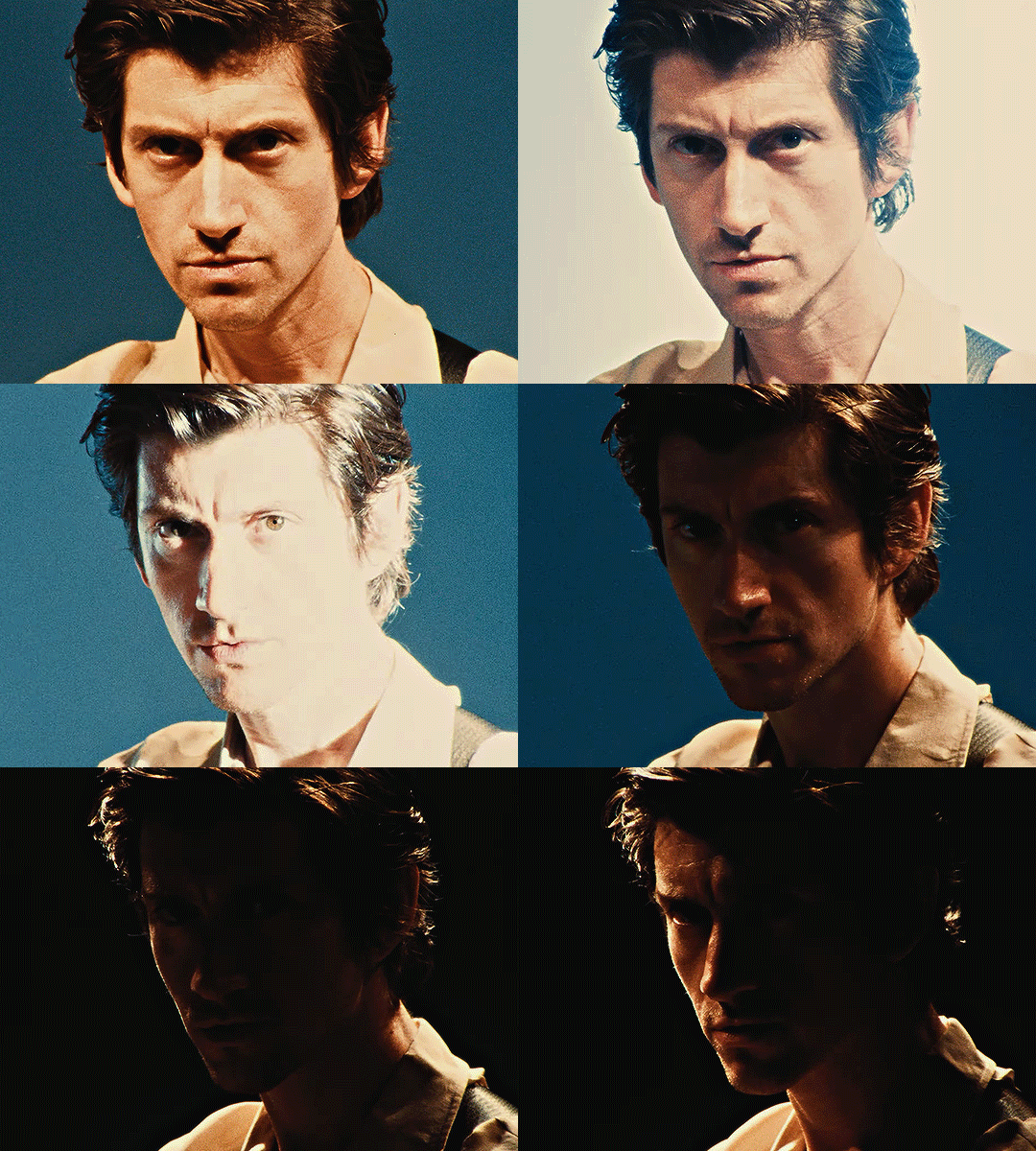
Yet, with all his vulnerability on the table, he is still hiding himself. References to the photoshoot, costume, and disguise, along with the overall cinematic theme of the album, leaves me to believe Body Paint is stage makeup. He is hiding under layers of it.
Mirrorball reads like an internal dialogue that stops and redirects as an apology to a lover scorned. There were two parts to it. I also believe the bit about “walking to the car”, is an extension to the new love interest, almost warning her of the baggage he is carrying.
Body Paint is an internal dialogue, reflecting on himself and the lover he left behind. The refrain to the outro “...on your legs, and on your arms, and on your face”, is the protagonist speaking to himself. In fact, the only line I believe involves her and the audience is in the chorus, “so predictable, I know what you’re thinking.” It’s almost as if he’s aware of her rolling her eyes at his pattern. And he is definitely aware of the audience watching, deciphering, and in a way judging.
The opening verse is straight forward. It is very reminiscent to the lyrics of The Bourne Identity, one that buried his past stage gimmicks. In this verse, he is aware of the many roles he hides behind and the mess they led him to. This could mean his stage gimmicks, or the masks he wore around his past lover. Following that with the tanning booth and sun line, paints an image of him hiding from the public eye.
“So predictable I know what you’re thinking.” This goes back to the “romantic fool” in Mirrorball. In a way he is aware of his patterns in relationships, and he scoffs at himself. Whether it’s sincerely endearing or an excuse, is not our concern. This reminds me of his interview for TBHC where he claimed to put in the line about “martial arts” in a song to hold himself accountable. This lyric in Body Paint, is not one we’re meant to hear.
The second verse is riddled with fear. Personally, I think it’s about him confessing that when a past relationship ended, he was afraid to check what was written, shared, or said about him on public platforms. Again, I turn back to an interview answer he gave on BBC Radio 1 in 2018, “You can always get a twitter account and set the record straight.” And he meant that as an anonymous account, a voyeur. Hence why he goes on to say, “you can poke your head behind the mountain peak. Don’t have to mean that you’ve gone into hiding.”
I feel as though that theory of being a voyeur, even though he is physically absent from this past lover’s life, is confirmed in the bridge. He’s watching her every move and feels his tears coming on. That to me, is a peak at his vulnerability. A straightforward response to a love ending.
This takes me to the core meaning of this song and the heart of Body Paint. Even though I prefer to break down songs as connected fragments of a full album, I have no doubt these specific lyrics embody the overall cinematic theme of this album and his overall mindset:
Straight from the cover shoot
There’s still a trace of body paint
On your legs and on your arms and on your face
And I’m keeping on my costume
And calling it a writing tool
And if you’re thinking of me, I’m probably thinking of you
Whereas the verses reveal his vulnerability, the bridge reveals the truth. Generally speaking, photoshoots exude a high vibrational energy. I think of smiling faces, beautiful lighting, scripted movements, flawless captures, and the enthusiastic shutterbugs.
However, in these lyrics, he’s illustrating an image of a stage or film character stepping away from the lights, but staying in character, with layers of body paint (makeup) concealing their truth. Think of method actors and how they stay engrossed within their role allowing them to channel through emotions they otherwise would prefer not to navigate outside of the role they’re playing. It’s a mask and his talisman in writing.
I think this is a glimpse into how aware he is of the part he played and maybe continues to play. That is of course confirmed in the following lines, and his thoughts of her.
And even though the line “on your legs, and on your arms, and on your face,” implies him speaking to another person, we can overlook the possessive adjective within the context of this song.
(To be continued: Part 2: Body Paint, the video)
 SPANGLED CAVERN
Body Paint is my favorite from The Car and I couldn’t haver asked for a better analysis. At first I thought it was a break up song as well. I just loved this part so much “The lyrics read like a diary entry. It is a confession. It’s him seeking atonement. But like Mirrorball, this song is the mark he wears, his Scarlet Letter.”
LikeLiked by 1 person
Thank you so so much!!!!!! Oh god this song I spent days, weeks analyzing because initially I thought the same until I heard his narration and it all just clicked so poetically.
Thank you so much, I tried my best haha! You’re so lovely
LikeLike
Thank you for this analysis.It was great when I first heard this song I thought it might be about like fans that love their old music and not accepting new sound.And how he knows what the are thinking about new album but still carries on doing what he’s doing.I loved this analysis so much it just so surefired
LikeLiked by 1 person
Oh thank you so much!!!! I have seen that theory flowing around but it never really resonated for me with this song. Big ideas has more of a reflection on how the fans received the new sound, same with that line from sculptures about bursting the bubble. Although Alex will never admit to it (and as most artists wouldn’t) I think he with those two songs I sensed him throwing shade at the fans and the public in general. And of course I don’t mean that negatively, and I’m sure he doesn’t either. Merely a reflection, an afterthought.
Thank you so much for taking the time to read through it I very much appreciate your time and your comment as well!! I love this part of the fandom so much because I truly do love the music.
LikeLike